
Three years, 24 hours, a disaster and a goodbye
Three years.
Three years since we arrived in Nepal, and it is already time to head back to Europe.

One year.
One year exactly since the country shifted into a new era with the “Gen Z” revolution.

Three weeks.
Three weeks since the Himalayan tsunami tore through the Trishuli Valley.

Twenty‑four hours.
Twenty‑four hours after our plane took off, our final departure, disaster struck.

The calendar had already set its deadlines, but fate decided to add a tragic twist.
We spent three years in Nepal exploring so many of its regions (though not all!),from its tropical plains, to its “hills” (even at 3000m, we learned to call them mountains only when they wear eternal snow),from its lush valleys to its Himalayan peaks.
We discovered cultural riches we never imagined: countless ethnic groups, their deities with family trees more tangled than the Terai jungle, artists tucked away in the most improbable corners, Newar architecture in Kathmandu, Tibetan monasteries in Upper Mustang, and religious festivals so numerous you’d need several overlapping calendars just to fit them all in.
Three years living alongside Nepalis whose kindness every guidebook praises, and rightly so. We’ve lived in more than ten countries, and nowhere have we felt as welcomed as in Nepal. We leave friendships behind that will, without a doubt, survive the distance.


Three years also of daily surprises,mingled with daily little frustrations. The policeman madly blowing his whistle in the middle of a chaotic intersection, contradicting the brand‑new traffic light above his head. The lazy dog sleeping right in the doorway of a shop, mimiking the shopkeeper you sometimes have to wake from her own nap. Garbage trucks dumping their load into the river under a bridge, out of sight. Electrical sparks setting fire to the shop next door because of poor maintenance… all the little everyday frustrations of a country still caught between a very present ancestral past and a modernity more endured than chosen.
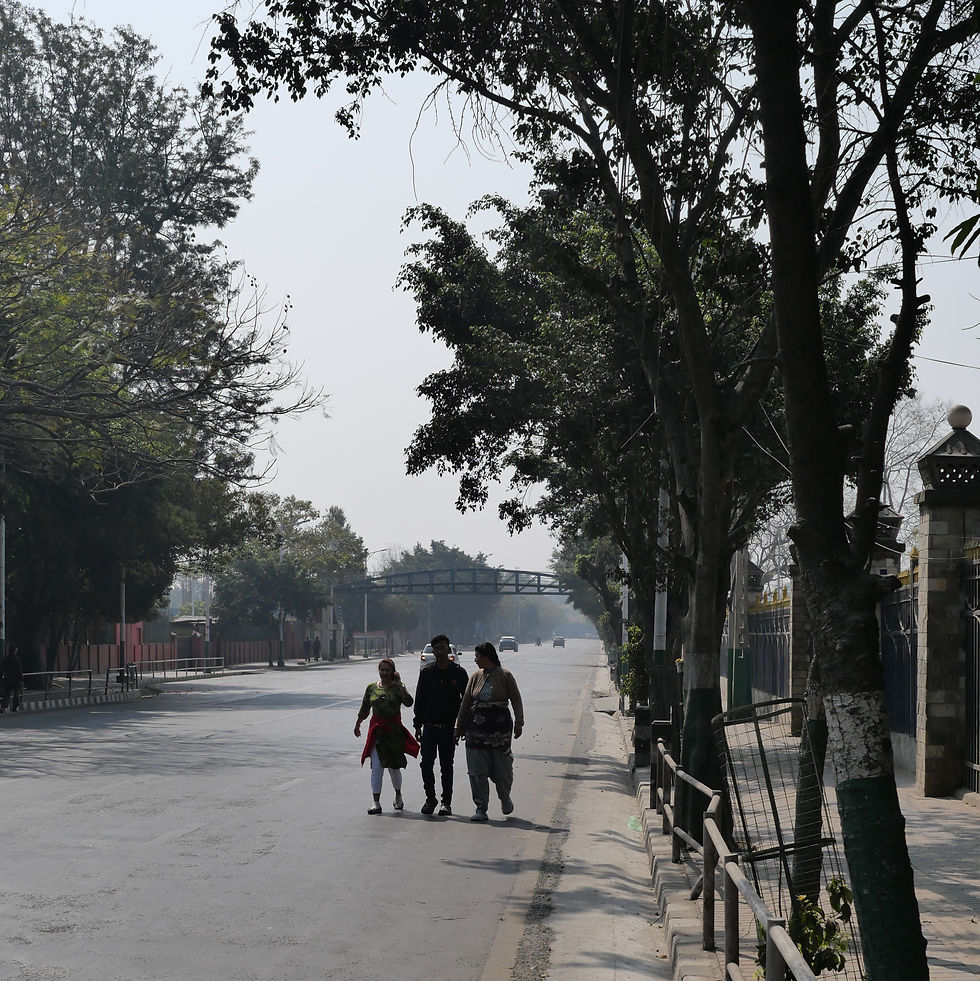
But three years watching the country change. Kathmandu modernizing, installing its first traffic lights, even building odd pedestrian overpasses to stop people from crossing wherever they want, paving its last dirt roads, putting up modern buildings where anything over five floors was rare when we arrived, letting trendy cafés and restaurants grow like mushrooms everywhere. Even high‑end hotels opening in the provinces to attract wealthier tourists. Electricity reaching almost everywhere now, with outages almost a thing of the past. The examples go on.
Three years also that despite this emerging modernity, the weight of the past remains, and the cost of transition grows. Women, for instance, still make up the essential but very undervalued backbone of daily life across all social classes. The caste traditions refuse to disappear, keeping power and wealth in the hands of a tiny minority. Rural migration empties the hills and overcrowds big cities that are becoming unlivable (Kathmandu is only one of them). Pollution, totally uncontrolled, kept worsening throughout our stay. And of course the accelerating exodus of young people abroad, which deeply reshapes the country’s social and economic fabric.
One year exactly since the now‑world‑famous “Gen Z” rose up, leading to a regime change. The new leaders were elected with a majority no one expected. Time will tell whether they can fulfill the hopes placed in them. We celebrated with relieved joy the perfectly organized, peaceful elections, on a memorable day when the entire city was car‑free.


Then came the enigmatic new prime minister, Balendra Sha, a former rapper permanently hiding behind his dark sunglasses.

We witnessed the first signs of reform and the promising fight against corruption, Nepal’s endemic curse. We applauded the appointment of young, capable, respected administrators replacing old regime loyalists. But we also saw the beginnings of a witch hunt against the economic elite, threatening investor confidence. We followed, alongside the Gen Z, the early investigations into the events of September 8 and 9, (74 people killed by gunfire), and realized the inquiry would stop halfway. The police violence of the 8th is well explained, but the chaos, victims, and destruction of the 9th remain unclear. Too many actors involved, probably: incendiary materials were distributed, target lists circulated… but by whom?
One year watching Nepal trying to reinvent itself. One year of real, though fragile progress. One year in which, like much of the population, we wanted to believe in a last chance for a country that has had 20 prime ministers in 20 years (to keep the stats going, Véronique had four during her three‑year stay).
But these last three weeks may have dealt Nepal its harshest blow in decades, presenting this young government with yet another obstacle it didn’t deserve.
Three weeks in which the Himalayas reminded the world how unstable they are. How much violence these majestic landscapes I trekked through can hide. How this country, already known as one of the most exposed to climate change, combines geological fragility with catastrophic glacier and permafrost melt.
Three weeks since massive torrents of water and rock rushed down that narrow valley at over 140 km/h, crushing and swallowing everything in their path. Three weeks earlier, we were standing on the banks of that same river, celebrating the end of our stay with Nepali friends.

Bridges we crossed, the road that led us there: gone.

The village where I started my first trek to Langtang is now buried under ten meters of mud, nothing of its houses is left.
Three weeks of watching Nepali rescue teams doing remarkable work in hellish conditions, tirelessly searching for survivors and trying to reach villages cut off from the world. Three weeks of tragedy we lived from afar, glued to our screens.

Because twenty‑four hours were all there was between us and the apocalypse unfolding in the country we called home for three years. Twenty‑four hours earlier, we boarded our flight home. Twenty‑four hours that don’t mean much, we wouldn’t have been anywhere near the wave in Kathmandu, nor would we have been able to change anything, but twenty‑four hours that will weigh heavily in our memories of Nepal. Karma, destiny, luck, coincidence… choose the word that best describes this strange way our Nepali stay ended. But those twenty‑four hours will stay with us.
So, it is now time to say goodbye to Nepal.
We’ve left this country we grew attached to, and with which we built a relationship I’ve tried to describe in this blog.
The twenty or so previous episodes are available from the homepage:

We would have liked to leave under calmer circumstances, of course, but we’ll return, as we had already decided before the floods, to continue discovering this fascinating country and its people, and to keep contributing to its development, in our very modest way, .
The simplest way is to make Nepal and its people known: by visiting (and by reading this blog!).
Several of our friends who have lived there almost all their lives are helping with relief and reconstruction, and can channel donations effectively through their associations:
नमस्ते


Comments