
Kathmandu is burning
Caveat: I am neither a journalist nor a historian. It's too early for history anyway, and I don't have the sources for journalism. These are therefore only instantaneous, on-the-spot impressions, which may be contradicted by future events, but authentic at the time. Some photos in this post are not mine but from anonymous authors who shared them on social media during the events.
Two days ago, the government proudly announced that most social media platforms would be blocked. This had already been the case about a year earlier, but limited to TikTok, the favorite digital gadget of the Nepalese youth. Back then,things had quickly returned to normal. TikTok (Chinese, as a reminder) had obsequiously taken the necessary steps and had promptly been reinstated.
So this time again, no need to get overly worried. Few, including us, even believed this blockage was possible. But finally, over the weekend, social networking sites began to creak, never actually blocked, but experiencing slowdowns and blackouts.

Prime Minister KP Oli doesn't have any children: he should be excused for not knowing that confiscating the digital gadgets of young people, these "Gen Z" as they call themselves, had the potential to seriously annoy them. And it did...
More seriously, a large number of people in Nepal use social media to trade online to supplement their income, and mostly to communicate with their relatives who form the 5 to 6 million diaspora abroad.
We've been feeling it coming for months, ever since our arrival almost two years ago in fact: It would only take a spark to ignite this society at the end of its tether, suffocated by years of inept governance and a sluggish economy riddled with corruption by a fringe of cronies replicating the feudal predatory system that prevailed for centuries. We had been witnessing with dismay their only escape: mass migration, as often mentioned in these pages.
And so, as our modern world goes, it wasn't a spark in the literal sense, but a silent click on a 20-year-old's phone that triggered this revolution.
As they had agreed on social networks whose blocking they had immediately learned to circumvent using VPNs, the Gen Z held a large demonstration last Monday in front of Parliament. From the beginning, their demands were not only the unblocking of the internet, but above all the end of corruption and nepotism maintained by the elites. The "Gen Z" movement had come to life.

(photo The Kathmandu Post)
What happened? Who gave the order to shoot? Why did the police obey, even though there never was any tradition of police violence in this country? Perhaps future investigations will tell.
The fact remains that within a few hours, the situation changed dramatically. First, 2 deaths were announced, then 14, today it's 31, with several hundred injured still in hospitals. Among them, middle school students still wearing their school uniforms, the youngest is said to be 12 years old. With live ammunition used, unfortunate blunders or incidents are ruled out. Not only in Kathmandu, but in several provincial towns as well.
Institutionalized blunders on a large scale: a state crime.
The tipping point was reached. On Monday evening, violence spread.
On Tuesday morning, demonstrating his complete incomprehension of the situation and his disconnect from the country he is supposed to lead, Prime Minister KP Oli issued a convoluted statement explaining the reasons for the internet shutdown. This was off the agenda since at least 24 hours: it was, literally, pouring oil on flames that were already burning.
His interior minister resigned and a curfew declared city-wide.
Perhaps one of his advisors could have paraphrased Duc de la Rouchefoucauld-Liancourt to Louis XVI and inform the Prime Minister that these were no longer riots, but a revolution?
Too late, violence is exploding.
This is probably the moment when "Gen Z" was overtaken by looters and gangs and lost control.
The Parliament is ransacked and set on fire.

The ministers' homes were also ransacked and arsoned, several ministers were lynched, Ceaucescu-like. One of them was even pushed into the river (which, cynics would say, was already polluted enough...). The army evacuated Oli and a few other ministers by helicopter; they have since disappeared, probably under heavy guard in barracks in the provinces.

The central power is no more, the government is dead, long live anarchy.
Early Tuesday afternoon, everything is still calm in our neighbourhood. A few street scenes contrast strikingly with the chaotic situation unfolding further away. Young girls even continue to pose carefreely by the local lake. Only a few shops are open, the streets are deserted, everything is calm and crushed by an unusual silence. The weather is beautiful and mild at the end of this rainy season. How strange it is to feel this calm, exaggerated by the lack of traffic due to the curfew, when the city is already burning further away.
From the rooftop of our house, I can see the fires spreading throughout the city. Helicopters fly over at low altitude.
The sounds of riots begin to rise from the surrounding streets. They are surprisingly easy to recognize, even without prior training. It must be hard-coded into human DNA.
In front of our home, some families placidly watch the first trucks loaded with excited protesters pass by. Some applaud. It's a strange feeling of being in the heart of the action, while still distant. A disconnect of the senses.
Are we witnessing the fall of the Bastille, a Himalayan replica of the Arab Spring, or a Tiananmen in the making?
Some wear stolen police uniforms, carry iron bars. Horns are blaring, people sing, dance, and set public buildings on fire.
The ministers' houses are set ablaze too.
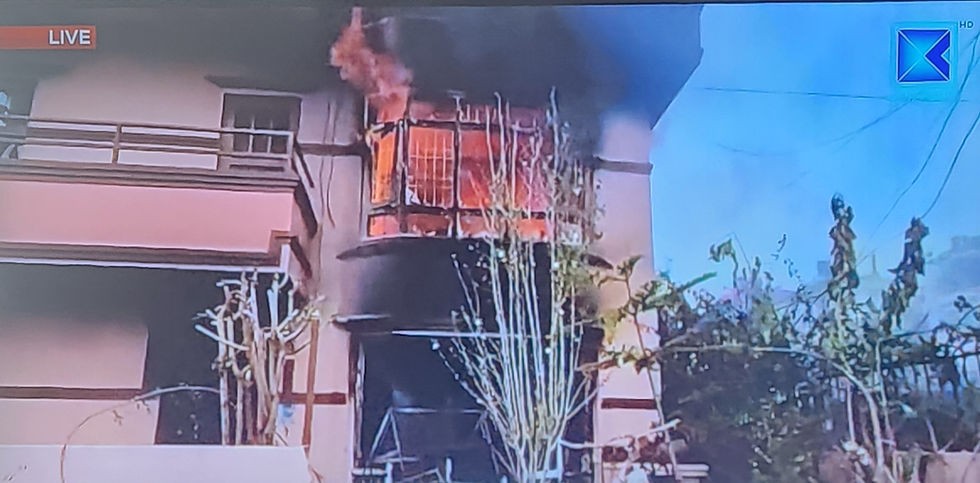
The police block the road almost in front of our house, leading to their headquarters. Behind them, the brand-new Hilton Hotel is ablaze. It is reportedly part-owned by the son of a former prime minister. Neither the police nor the fire department appear to be intervening.
A prison housing the main political opponent was attacked and the opponent released...and along with him, 15,000 common law prisoners (across the country) who rushed to steal weapons from vandalized police stations.
Are we still in a student party badly gone wrong, a thug revolt, or a historic revolution? All of the above at this moment probably.
The riot police are present but completely overwhelmed; they don't even seem to be trying to contain the disorder anymore. The army is also absent.
Night falls, and fires spread their acrid smoke across the city. Ambulance sirens echo in the distance.
Kathmandu is burning, night is falling, Nepal is sinking into the unknown.
Early in the night, the Chief of Staff finally made a televised statement, calling for calm. But without proclaiming himself as interim government.

The Nepalese army has traditionally been very respectful of constitutional rules; it is one of the rare examples in the region where the military has never even had a passing influence on political power.
Thus opens up a new chapter for Nepal.
The next morning, as the army is deployed throughout the city, it is raining, which probably helps keep the rioters indoors. The influence of weather on revolutions can never be overstated !
The city is plunged into an eerie calm. Although the curfew is in effect, I still take a walk around our surroundings. A few small shops have reopened.
Housewives in saris pass soldiers camouflaged as if they were in the middle of the jungle.

The Hilton is still burning, the most recently built hotel in Kathmandu is now completely destroyed.

Every police station in the city center has been burned down, along with Parliament, the Supreme Court, and anything that resembles an official building. Every road crossing is littered with ashes and the wreckage of burned-out vehicles.
Business savviness of some and ridicule of others know no bounds: idle rickshaw drivers take stunned tourists on tours of the still smoking ruins.
How can so much be destroyed so quickly? It was only yesterday afternoon...
On this gray, rainy morning, the heavy silence brings out the sound of footsteps in the street. It feels like waking up in the morning following a way too wild party: massive hangover and an upside-down house littered with empty bottles... on the scale of an entire population, of an entire country.
Passersby pass, guards stand guard, a monk makes a phone call, an old woman prays in a little shrine, children play ball.

It really takes a lot to stop the flow of daily life. Burnt-out car wrecks are cooling off.
Power is still vacant, Gen Z is also hungover, its revolution has been stolen .The society is traumatized by all these young people killed and infrastructure destroyed.
But now, at least, the old guard is gone. The field is clear, the page is blank, even if stained with a few scorched spots. Either on a blank page or a smartphone screen, the users manual to rebuild the country will have to be written.
This was the first Gen Z revolution.
Will Nepal be the first country writing a ChatGpt constitution?


Comments